Monday, December 15, 2014

The Teenage Trap


A teenage boy of the 1950's is cruelly forced to dance with a broom as punishment for his communist beliefs.


In the 17 years since I technically ceased to be a teenager, I’ve been stuck in a teenage trap of blaming my parents for my problems. I dwelt on the scars of my formative years, holding my mom and dad ultimately responsible for all of them. I thought those experiences were the reason I've failed as an adult. Though they've had a profound effect on my personality, there are plenty of other factors that explain my lack of professional and social success.

The problem was I couldn’t move on from adolescence. There was no fulfilling adult life to drape over the pain of coming of age. The existence I’d scrabbled together after college melted away over time, exposing the unresolved emotional detritus of my childhood and teen years. I couldn’t take comfort in a rewarding, well-paying job that gave me a sense of contributing to the Welfare of Humanity. I couldn’t bask in the love of a significant other to get me through the rough patches. And, perhaps most important, I could no longer rely on a collection of supportive friends to ease my fears. I was thrown back on my seminal resources, i.e. my parents.

Luckily for me, they had the patience and generosity to put up with my adolescent sulking for the last 24 years. But I worry about the many members of my generation who appear to be going through the same hardships as I whose family or friends aren’t as supportive as mine. Like most Americans, they may blame themselves for their failures. Even though I railed against Capitalism and the pathetic state of American education, I considered myself too smart to fall victim to the same obstacles that were holding my peers back. After all, I was great at school, and isn’t that the best preparation for the adult world?

If anything, my success in school condemned me to corporate serfdom. I learned the lessons of public education too well. I internalized obedience to authority and ignored many creative impulses that would’ve cost me academically. School drummed a lot of common sense out of me, especially the instinct to question authority when its decisions don’t make sense. I let any initiative I might have had wither on the vine, because, in school, it did me more harm than good. Consciously or not, Academia wanted a drone to plug into the Corporate Matrix, and that’s what I gave it.

A strong, well-informed support network might’ve saved me from this fate, but I grew up in the suburbs in a pseudo-community. When I moved to Chicago after college, I lacked the social skills to make friends of urban dwellers or form relationships with neighbors (not that they seemed interested in getting to know me). Once the friends I made in college and of post-college roommates drifted away, I had only my family to depend on. If I had bad parents, I would’ve been screwed, and I think that’s the situation a lot of people my age find themselves in: estranged from family and friends, left to fight the predations of Neo-Liberal Capitalism alone.

Nowadays, young adults are presented with a depressing choice. We can either work for the Man or try to make ends meet some other way. Both choices have insidious emotional consequences. Buying into the System can leave us feeling like a hypocrite and a traitor to our own principles. In my experience, a spiritual rot sets in that robs us of the comfort we seek. If we try to chart a morally upright course, the stigma of poverty may sap our confidence and self-respect. Economic dependence on our family, friends and/or the government undermines our sense of agency, maturity and vitality. We may resent our parents even when they're supportive, because we feel infantilized by their assistance.

But I would say that, even if we “sell out,” any success we enjoy comes largely through our own ingenuity, resilience and other skills they don’t teach in school. The economy has been working against most Americans since the late 1970’s when Jimmy Carter (followed by every succeeding president) introduced Neo-Liberal reforms that continue to put greater power in the hands of Big Business. This has led to the weakening of the social safety net and the triumph of the philosophy that self-gratification is the only worthwhile, attainable goal of Modern Life.

Following this blueprint due to economic necessity or social conditioning, our parents raise us with the “help” of television and the internet. We’re exposed to commercial messages that instill the belief that happiness can be gained through the acquisition of material goods and creature comforts. We’re measured by our performance in schools that suppress creativity and encourage submission to authority. We’re told to go to college and grad school, further delaying adulthood. Then we’re thrown out on our own in an increasingly cruel, lonely world that has little use for our credentials, but will gladly exploit our desperation to pay off the debt we’ve been saddled with. Stripped of resourcefulness and vocational alternatives, we line up for the corporate meat grinder.

To fend off despair, we angrily search for scapegoats. We blame ourselves, our parents, God, the Universe, everything but what I consider the real culprit: The Powers That Be, the nexus of corporate and government authority that runs things in the USA and most of the world. Sure, we often blame them for all the world’s ills, but how often do we believe that we have been personally thwarted by the Establishment? How often do we think we didn’t get that job or that apartment because of the System? This is a tough pill to swallow for a member of the middle class, for we have been raised to believe that the System may not work for everyone, but it works for us. If this is no longer true, then we must face the grim reality that we now have the same status as the working class and the poor and are vulnerable to the same machinations of the System that demean, dispossess and, sometimes, kill them. This may be why the protests over police killings of blue-collar African-Americans have found such broad support; many of us white-collar Euro-Americans feel like we could be next.

Our society’s individualism discourages us from blaming the Power Elite. The American cultural narrative of self-determination tells us that we are the captains of our fate. Supposedly, our socioeconomic structure is designed to free us, not imprison us. Ergo, our failures are a result of our own inadequacy. Despite the mounting evidence to the contrary presented by the collusion of Big Business and Big Brother (the government), we still cling to this belief. It’s difficult for us to accept that we may be at the mercy of forces beyond our control. It offends our distinctly American sense of autonomy. It can also be extremely depressing, for what is the use of keeping up the good fight when your fate has already been sealed?

The most viable paths out of this nightmare seem to be the individual ones, the ones we take alone. The option many people in this situation think of is to drop out of the mainstream society, which seems extremely risky and lonely. But I suppose it's no more isolating than being surrounded by people who either believe in an inhuman system or are resigned to its dominion. Social atomization has discouraged us from joining or starting a grassroots movement to change things. We’ve been taught to believe that such efforts are more trouble than they’re worth and ultimately futile. (I realize these claims aren’t consistent, but anyone expecting consistency in propaganda is sure to be disappointed.) Thus the System keeps us detached and (mostly) obedient.

Growing up middle-class in the suburbs may seem like a charmed life, but it has left me high and dry as an adult. As Late Capitalism feasts on what’s left of the New Deal and the Great Society, the skills and habits cultivated by our upbringing and schooling actually make it harder for us to stake a claim in the New Normal. The country we’ve inherited falls far short of the one we were promised. It’s a land where all but the very wealthy are subjected to an experiment in Social Darwinism.

The good news is we can fight back, but we have to overcome our socially-conditioned tendencies toward radical individualism and materialism. Corporate America would like us to remain forlorn teenagers for the rest of our lives. It prefers us as slaves to our “throbbing biological urges” and passions, looking for a quick fix of consumption to soothe our anxieties when the System denies our efforts toward liberation. But we can reject this programming and become real adults, that is, people who recognize their responsibilities to themselves and each other. Through such a revelation, we can rebuild community and collaborate on projects that develop the human spirit and overcome the mechanization and commodification of human life.

Friday, December 12, 2014

Confessions of a Nice Guy

Early-80's Tears for Fears would like to wish you and yours a Happy Holidays!

After all my self-righteous indignation about Assholes and the supposed failures of Feminism, I have to come clean: I ain't no Nice Guy. On multiple occasions, I've treated women with something less than chivalry, and all because I was desperate to get laid. This is the tragedy of the Nice Guy. I got nowhere with women, and I blamed my Niceness for holding me back. I should've blamed my shyness. ("Confessions of a Shy Guy" might be a more apt title for this.) But, temporarily, the Niceness got the old heave-ho, and I became what I claim to despise: an Asshole.

The Nice Guy Theory of Virginity was an easy answer, which is why I embraced it. It was self-aggrandizing to think that I was too nice instead of too shy. I could cast myself as the victim of Woman's Inhumanity To Man, instead of the victim of my own personality, cowardice and grim visage. I didn’t have to look in the mirror or do any of the hard work it takes to improve oneself.

I didn't lose my virginity until I was 31. Even 6 years later, I'm still hesitant to share that. The shame I felt about it was staggering. But I certainly wasn't a late bloomer in terms of my interest in girls. I had some smooching sessions with a girl (Ah, Naomi.) in first grade and enjoyed them very much. Then middle school came along and destroyed my self-confidence and my relationship with my parents.

The Nice Girls who had been so nice before puberty didn't seem interested in dating me. (There's a good chance they were, but my low self-esteem blinded me to those possibilities.) The only girl I asked out in high school (over the phone, of course) said she'd "have to think about it." (Yes, even 18 1/2 years later, I still remember her exact words.) Even though we had a class together every day, she never gave me an answer, and I never mentioned it again. This was a painful betrayal and resulted in a long-standing grudge against Nice Girls. That's another problem with being a Nice Guy. If the few times you ask a girl out don't go well, you become even more reluctant to stick yer neck out.

Predictably, college kicked off with a couple (tacit) rejections to wipe out the uncharacteristic confidence with which I'd arrived on campus. There were probably many opportunities to sow my wild oats, as is the custom, but my self-esteem had been knocked down to its previous, miserable condition. As I progressed through my 20's, the shame and anxiety about being a virgin kept growing, which obviously didn't help my nerves around the ladies. I carried my virginity around like a cross, hoping no one noticed the gaping hole in my adulthood. It contributed to my nervous breakdown at 27. To recover, I cemented a few strong friendships and repaired some of my relationship with my parents. After that, I wasn't as anxious about it, but I was still extremely eager to throw off the psychological burden.

Ironically, I think the gentlemanly way to do it would've been a casual hookup, as long as I was upfront about my intentions. But that would've required a boldness and straightforwardness that I lack in spades, so I took the "easy" way out. I found a girl on an online dating site, tricked her into developing feelings for me and then dumped her after we'd had sex a few times and the guilt became unbearable. It's a story as told as Time. This happened in November 2008. The joke I came up with later was that, after a black man was elected President of the United States of America, the Universe figured anything was possible and finally let me have sex.

Granted, I'm being very reductionist and kinda hard on myself, but that's it in a nutshell. She was very nice (in the real sense), but I didn't feel a strong emotional connection with her. I expressed affection for her, most of which was feigned. It wasn't totally fake, but a lot of it was just the warmth I would feel for any decent, pleasant human being. I also let myself get swept away in many "tender" moments. I take some solace in the fact that, after a month, my conscience was killing me, and I broke it off as honorably as I could (over the phone, of course).

A year later, I went through a similar, month-long routine with another woman. I could've ended it better, but it wasn't a total mess. It didn't really matter, because I wasn't interested in being friends with either of them afterward. I didn't think we had enough in common even for that. I just wanted the sex. In the parlance of the streets, I "hit it and quit it."

As disingenuous as it sounds, the truth is I'm a hopeless romantic. In elementary school I could cry at the drop of a hat. But middle school taught me (and many other boys) that crying is for girls. My heart was filed away and only brought out on rare, safe occasions. Anger took the place of sadness, and my sensitivity was replaced with a hard shell of apparent indifference. I really haven't had a good cry since I was 12.

Failing to get a girlfriend or get laid eventually turned me into an (internally) angry, bitter, resentful Asshole. I gave up on romance and took the easy (or sleazy) way out to rid myself of the stigma of virginity. Of course, having sex didn't fix my emotional problems. I was still desperate to have a girlfriend, to be in a romantic relationship and feel that love, warmth and intimacy (both physical and emotional) with a woman.

This was largely a result of my broken relationship with my parents, especially my mom. I think the yearning for sex was really a need for unconditional, unguarded love and emotional intimacy. I don't know why it was redirected as sexual desire. Perhaps to distract me from its essentially emotional nature, so I wouldn't have to think about the real problem. It's also much safer emotionally; sex without love exposes far less of the heart than love alone.

I think I’ve taken care of my issues with my parents, but I still have a ways to go in fixing my abandonment issues in the wake of losing touch with many close friends. This essay is a good step in that process, I think. It feels like a moral and emotional "cleanse,” like something someone in Los Angeles would have done periodically at a clinic for a ridiculously inflated price. But I don’t have that kinda money, so instead I blog about embarrassingly personal things. You could call it the Confessional Cure.

Sunday, December 07, 2014

The Asshole Theory

Well, once again I'm left to ponder why my romantic overture to a girl came up empty. One at a time, each detail of the event will rise to the surface of my mind for thorough examination. Should I have asked her out in person when I had the chance? Was the email a mistake? Was I a complete goober for phrasing it "If yer keen, we should hang out sometime?" Is this all just pointless self-flagellation because she was never interested in the first place?

When I step back and think about it more rationally, though, this incessant fretting over minutiae feels more like a defense mechanism than an objective assessment of my performance. I think I'm just trying to protect myself from the far more likely possibility that she's "just not that into me." That potentiality is much more depressing than thinking I did something to put her off.

Of course, imagining that she (tacitly) declined my offer because I emailed instead of asking in person is also troubling. I certainly hope she didn't hold my shyness against me. It would be a mistake, I think, to dismiss someone (male or female) for being reserved or even socially awkward. To cite a couple of cliches that have been quoted so often we usually ignore them, you can't judge a book by its cover, and still waters run deep.

It bothers me to think that women may be more attracted to bold men. Several years ago, I came up with a theory that explains, at least to my satisfaction, why confidence isn't the best quality by which to judge a suitor. I call it "The Asshole Theory," and it goes like this: It's easy for assholes to be confident with women, because they aren't emotionally invested in the outcome. Assholes just wanna get laid by a chick, any chick; they're not looking for a relationship or a personal connection. If they get shot down, they just move on to the next target, because to them the objects of their desire are just that: objects.

This is why it pains me when the lady in the Match.com commercial says, "I live my life, and, if somebody comes along and talks to me, that's how it goes." It seems like a lot of women approach romance this way. Well I've got news for ya, ladies: We ain't livin' in the 50's anymore. You wanted equality, and, even though we're not there yet, we've certainly come a long way. But with more rights come more responsibilities. In other words, if you wanna date Nice Guys, yer gonna hafta make the first move sometimes.

[Excuse the colloquialisms. I often lapse into urban (Southern? Hard-boiled film noir detective?) vernacular when I get worked up.]

Speaking as a (hopefully) Nice Guy, I have to say that ever since I hit puberty I've been disappointed in how passive women seem. Feminism has let me down. I thought girls would be asking me out on a regular basis. Not because I had a high opinion of my own attractiveness. (I didn't and still don't.) I just thought that's how it would go. Most of my bosses have been women, yet when it comes to dating y'all seem stuck in the past.

But, again, when I stop to really think about it, I'm forced to admit that I've been hit on about as many times as I've hit on girls (or women). If you count the times I've been hit on without realizing it, they probably far outstrip the times I've made the first move. (But I don't count those. Sorry. If your intentions aren't clear, it doesn't count. This is another problem. Women usually wanna communicate by Morse code, but men generally only understand semaphore.) It leads me to believe that my lackluster lovelife is a product of my shyness rather than a failure of Feminism.

Then I see something like the catcall video, and I become horribly ashamed of my gender and wonder how women even get out of bed in the morning, much less routinely pass me on the corporate ladder. It makes me much more understanding of women's passivity and seemingly old-fashioned perspective on dating when I see how many fucking assholes and Neanderthals are out there. After I saw that video, I realized that I have an obligation, as a Nice Guy, to stick up for women who are being harassed. Women can't overcome the rape culture on their own. We men who don't want that in our society have to stand with them.

Which leads me to my conclusion, that I have to take a more active role in my own lovelife, as any shy person (male or female) should. At the end of the day, my ruminations on "the failures of Feminism" are probably just another example of a middle-class white guy bitching about not being the lord of all he surveys anymore. It's not like I have to overcome major obstacles to find true love, like women still do. I just have to deal with the fact that things aren't as easy for guys as they used to be. The world is changing, and we all have to adapt.

Friday, December 05, 2014

Hate the War Crimes, Not the War Criminal

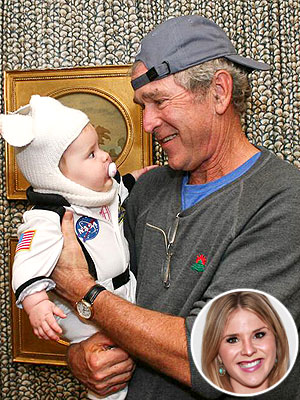
While searching for a very different kind of photo (Don't ask.), I found this picture of former president George W. Bush holding his grandson. I have to say, it melted my heart. All the rage toward him I accumulated since my political awakening of 2004 just disappeared. I was reminded that he's still a human being, endowed with all the foibles, passions and graces endemic to our species.

That isn't to say he isn't a war criminal, because, technically, he is. But it's worth remembering that war criminals are people too. Hating someone, no matter how heinous we find their deeds, is a destructive activity that dehumanizes us as well as the object of our hatred. As the saying goes, "Don't hate the player; hate the game."

In the spirit of that wise, old axiom, I will continue to hate the machinations of the Military-Industrial Complex while trying not to hate the people who carry them out. Besides, what did all our hatred of Dubya get us? A Democratic president whose foreign (and domestic) policies are virtually indistinguishable from his predecessor's and a bunch of Democratic members of Congress who continue to fall in lockstep behind the Power Elite.

Yet we on the Left don't hate Obama or any Democrats with anything like the passion we directed at Dubya. So what does that say about our hate? That it has little to do with reality or effecting beneficial change in the world. Anger can be harnessed to achieve worthwhile goals, but when it turns into Hate, we are the ones who have been harnessed. At that point, Hate is holding the reins, and it has no interest in doing good.

Monday, November 24, 2014

Escape from the Shadow Realm

In the words of the Grateful Dead and Soul II Soul, what a long, strange trip it's been back to life, back to reality. I finally seem to be coming out of a soul coma. For the last few years, I've been plagued by a sense of unreality, a feeling that the world and its inhabitants are unreal or (more often) that some inter-dimensional haze separates me from everything (and everyone) else. The effect is mainly emotional, but I'm most aware of its visual component. It slightly blurs my vision, softening all edges.

Apparently, this is a symptom of Depersonalization Disorder. I discovered this quite by accident when I looked up Adam Duritz of Counting Crows on Wikipedia. On an episode of the hit podcast Jordan, Jesse, Go! one of the hosts (Jordan) said Mr. Duritz's dreadlocks were fake, so I decided to conduct some independent research. I was unable to confirm that claim, but I did learn that he experiences the aforementioned disorder, which is marked by a feeling that the world isn’t real.

Usually, I would be relieved to learn that my condition has a name and afflicts others too. But that revelation increased my anxiety. For some reason, I wanted to keep this malady to myself. I wanted it to remain personal, unique and nameless. I didn't want to label it with a clinical diagnosis. My bouts of depression often provoke this reaction: “Must sadness always be pathologized? Can't I just be bummed out? Isn't there enough pain and suffering in the world to justify being down in the dumps?”

I've been out of phase with Reality since the fall of 2010, but it feels like I’m almost all the way back. I keep bursting through fuzzy membranes of distortion that were cutting me off from the Real World. It's like I'm traveling through dimensions, getting closer to my home dimension, but never quite there. I'm striving to put right what once went wrong and hoping that the next leap will be the leap home. (Sorry, I had to.) The goalposts keep moving. The closer I get to Reality, the more I notice the sensations that are still missing. I didn’t even notice my sense of smell had diminished until it returned in full force a week ago.

This case of Depersonalization Disorder must be a result of repressing emotional pain. I think my mind has tried to escape reality to avoid the stress and misery of my situation. My closest friends stopped calling me back, and I failed to find any new friends with whom I connected emotionally. The only jobs I could get were of the soul-crushing corporate variety. My cousin, with whom I’d been living, moved back home to Chicago, and I didn’t want to live with strangers anymore. Therefore, I moved in with my parents for what was supposed to be one winter, but which just passed five years. My relationship with them was still broken from adolescence and fraught with tension and anger. By pretty much any measure, I should’ve been despondent. Internally, I conformed to that expectation, but I was unable to process my grief.

In the absence of constructive action to extricate myself from this predicament, my brain took me out of my rut and whisked me away to the Shadow Realm. The world became a ghost town and the people tumbleweeds. I could still see and hear them, but their actions didn’t have much positive effect on me. However, even benign comments and deeds were enough to trigger my anxiety. When nothing anyone is saying or doing makes you feel better and often makes you feel worse, I guess turning everyone into a wraith is a logical defense mechanism. It comes in especially handy when your friends disappear, because the transition from ghost to empty air is less jarring than that from corporeal being to nothing.

This parallel universe was safe, but it was also boring and lonely. Nothing was worth doing, because I was numb. Since everyone was a shade, physical contact felt illusory and emotional connection vanished completely. I wasn’t willing to open up to the only people who were emotionally available to me at the time. I lost the ability to connect with new people. I was too afraid to open up to them, feeling like I’d been emotionally abandoned by my family and all my closest friends.

This isn’t the first time I’ve withdrawn from the world. It’s a habit I developed as a child. I would routinely plunge into the abyss of TV rather than attempt human contact. My parents had to force me to go outside and play with the other kids. Socialization has always offered me greater rewards than television, but it also offers greater risks, foremost among these, rejection. Being a sensitive boy, I was an easy target for verbal abuse as the new kid in elementary school and then as any kid in middle school. By the time I got to high school, I’d already had my fill of rejection.

That pain has driven me to flee the company of people many times. I often wish I could live alone and keep the world at arm's length to avoid being hurt anymore. If it were up to me, I would live Jorge Luis Borges's "life of the mind." I would lose myself in fantasy, TV, movies, music and books. For about half of my two years in Chicago, right after college, I realized that dream. Discovering that all my bachelor’s degree entitled me to was a seemingly infinite string of temp jobs left me bitter. I wanted nothing more to do with a society that had convinced me a college degree was the Key to the Kingdom and then, once I got one, still denied me a stable, white-collar job. I retreated into my apartment and spent my days watching TV and playing video games.

But the peace of solitude quickly curdled into paranoid isolation. Each day became a repetition of eating too much, watching too much TV and staying up too late. I was lonely, depressed and obese. This is what happens whenever I spend too much time alone. Physical symptoms crop up that are severe enough to convince me I need to overcome my fear of rejection and re-engage with people. Ultimately, my body is the one that keeps pulling me back into the World.

There’s always been a tension between my desire to be in the middle of Life, amidst teeming Humanity with all its joys and troubles, and my desire to be free of those obligations, indulging in solitude and serenity. I assume most people have to deal with that tension and strike a balance between the stress of engagement and the loneliness of isolation. I’m usually overwhelmed by the stress and easily hurt by my family and friends’ perceived rejection or abandonment. If you’re grateful for my continued participation in Life’s Grand Pageant, you can thank my unconscious. If it were up to my conscious mind, I would’ve checked out a long time ago.

I think this desire for escape is fueled by our Lonely Society. I doubt it would be so easy to slip into the Shadow Realm if I were part of a true community, like in the Olden Days. Those personal connections are what keep me rooted in Reality. Having supportive family and friends gives me a feeling of self-worth that convinces me living in the Real World is worth the pain and struggle. On my own, I’m liable to lose touch with Reality and fly off into a void of despair at the apparent futility and cruelty of Life. The love of my family and friends (eventually) convinces me to stick around by renewing my faith in Humanity and giving me hope for the Future.

Wednesday, September 03, 2014

Waiting for the Waterworks

My emotional recovery proceeds apace. (I had to look up "apace." It means "quickly," which is good, because I really wanted to use that sentence.) Yesterday, it went faster than I could handle. I was having dinner with my parents, and I was consistently amused by their conversation, which hasn't happened since I was about 12. It felt good to let in the joy without putting up the usual barricades against my folks.

Unfortunately, after I went downstairs to watch TV alone, I had an anxiety attack. It felt like a burst of uncontrollable energy. It didn't last long, but the anxious energy lingered in my chest, so I took a Lorazepam. I've only used 3 of those sedatives since I got the prescription in May, and they're mild anyway. I turned off the TV and meditated briefly on the floor. That seemed to help more than the Lorazepam.

I went upstairs and told Mom and Dad about it. They were helpful. I said I must've gotten too much energy from our dinner conversation. It's also kinda scary to feel like you've finally fixed your relationship with your parents after 24 years. The last time we had a strong relationship I was 12. I don't know what a healthy adult relationship with my parents looks like. I don't know what the repercussions will be. They should be good, but they're still unknown.

Maybe the main reason I'm afraid is that I'm making myself completely vulnerable to my parents again after 24 years. I still feel like they've let me down in the past. But, after re-examining our history with an empathetic mind, I think their mistakes were the result of good intentions or common human flaws. Still, though, that's a long period of distrust to overcome.

But I'd be willing to bet the primary cause of this distress is my inability to cry. That was the other emotional bridge that broke down when I hit puberty (and started middle school). I think if I could cry, esp. in front of my parents, that would go a long way toward healing me. A lot of pain has built up in the last 24 years. I'm not saying I haven't released any of it, but I'm guessing some of that old pain is still causing me problems, still waiting to be liberated.

It would also be nice to be able to process emotions healthfully. In elementary school, I cried often. My stone face didn't take over until I got to middle school. Fully opening up to my parents could re-open the waterworks. It means changing back into someone I haven't been since I was 12. Change is scary, as is being emotionally vulnerable. I'll have to proceed cautiously.

Sunday, August 31, 2014

Taming the Doomer

After a difficult summer, I've achieved some sense of emotional security and stability. But still the Doomer insists that I'm surrounded by fools. I walked through the Augsburg campus today and saw a large circle of college-aged kids. (I'm guessing they were college-aged, because nowadays college kids look like high school kids to me, high school kids look like middle school kids and so on, although infants still don't look like fetuses, thank God.) The Doomer just wanted to point at them and shout, "You're all doomed! DOOMED!"

I've come to accept the Doomer as an aspect of my personality, an incorrigible child of the Dark Side who must be kept in his corner. He acts out every now and then, and that's when he needs a timeout. This taming of my Doomer has been instrumental in my emotional recovery. I've had to learn to look on the bright side and not wallow in pessimism. It has helped me recognize the subjectivity of my perspective and realize that happy people aren't oblivious; they just have a different, arguably better perspective.

In my solitary wandering, I've often seen happy people and thought them stupid. My mind would ask, "How can you be happy in this vale of tears?" I usually diagnose this reaction, correctly, as envy. I'm lonely and resent their apparently happy, friend-filled lives. But the persistence with which I've discredited happiness as ignorance imprinted that equation on my psyche. I came to distrust happiness in others and myself as a symptom of naivete or willful blindness.

In order to climb out of a hole of anxiety and depression, I had to re-program my brain to accept happiness as a legitimate response to the world, even with all its injustice, pain and suffering. The things that had previously supported my sense of self-worth (living in a hip neighborhood, working a job that paid the bills, hanging out with friends with whom I felt strong emotional bonds) were lost.

I was forced to expand my emotional aperture to accept support from sources I'd been rejecting, most notably my parents. The friends I have now aren't as artistic or sensitive as my old friends, but I've learned to focus on their strengths and avoid their weaknesses. I've also tried to reciprocate their loyalty, no longer expecting the relationships to be one-way streets of encouragement. Once I pulled back the curtains to let in more light, the Doomer had fewer places to hide.

Wednesday, August 20, 2014

Li'l World

At least a year after my 2005 breakdown, the world began to appear small to me. The rooms of my apartment, the houses that I walked past, the skyscrapers that filed past the window of the buses and cars I rode in. They all suddenly looked small. For some reason, my visual perception of the size of the world had changed. It was as if the world had been warped and shrunken to fit inside my anxiety-addled brain.

It was a depressing development. Formerly, the world had intimidated and fascinated me with its size. I loved to gaze up at skyscrapers in Minneapolis, Chicago or New York and stare across the vast expanses of flat farmland while driving through the Midwest. I was usually nervous when in public, and being in the presence of a large feature, like Times Square, increased my nerves. At the same time, though, it excited me. 

But I could no longer lose myself in the world's labyrinth. I walked the city streets, but really I was only walking the streets of my own mind. There was no interaction to take me out of my head. The strangers passed wordlessly, reinforcing the sense that this world was just a figment of my imagination, an illusion meant to torment me with the unfulfilled promise of connection.

This shift in perception was later supplemented with increased confidence and a lack of interest in taking part in the world. Even though I had a new-found serenity, I had no desire to put it to use by making friends, dating or pursuing my artistic aspirations. I just wanted to keep watching TV in my apartment and hang out with my roommates. This seems to have been another symptom of depression, the sense that the outside world had nothing to offer me.

I recovered from the apathy, but that feeling of living in a diminished world still crops up on a regular basis. The key to fighting the depression seems to be engaging with people socially, especially strangers. It takes guts for me to venture outside my Minnesota comfort zone, but it's good for me and hopefully my sociability will "go viral," as the kids say.

I think it would be good for most Minnesotans to adopt this habit. Here are some ideas I came up with for a Minnesota PSA: "Friendliness: Pass It On!"  Or "You're an Adult. It's OK to Talk to Strangers Now." Or "Talking to Strangers: It's not just for at-risk youth anymore!" One of those should do the trick.

Sunday, July 20, 2014

That Deep-Down Body Thirst

I've been walking the streets of Uptown, Loring Park and Downtown all day, trying to perpetuate the illusion of constructive activity in lieu of employment. That kind of self-delusion can work up a powerful thirst in a man. And I don't mean no tap water thirst. This ain't no Brita water thirst neither. Nor is it the kind of thirst that can be quenched by your Vitamin Water or your Sobe or any of those high-classed, namby-pamby, pantywaist beverages. No, this is the kind of deep-down body thirst that can only be quenched by a man's sports drink, the kind of liquid ya need after you play pickup basketball for 106 straight hours in the blazing sun, or you run 12 marathons in a row, or you build the Hoover Dam.

How I do love Gatorade, with its electrolytes and complex carbohydrates and flavors not found in nature, like Orange, Grape, Lemon Lime, Fruit Punch, Strawberry Kiwi, Tropical Mango, Citrus Cooler, Cool Blue, Cool Glacier Blast, Frost Glacier Freeze, Frost Cascade Crash, Frost Riptide Rush and Cold Fusion Reactor.

It smacks of summer scorchers, walking down the sidewalk with the sweat drippin' off ya, stopping at the convenience store and reaching into the cooler for a cold, plastic bottle of watered-down, Kool-Aid-for-diabetics sweetness. I had a few more blocks til home, but it didn't matter with those electrolytes replenishing my dangerously-low supply of electrolytes.

It also makes me feel athletic. When you drink Gatorade, you're showing a firm commitment to hydration. You're telling the world, "I refuse to let the elements stand between me and my appointed task. Even if my appointed task is to pick up some cheddar and sour cream potato chips, French Onion dip and maybe a pint of Ben & Jerry's, I will dedicate myself to its successful completion as if I were picking up Brett Favre at the airport or repelling Pickett's Charge at Gettysburg or driving my wife to the hospital to give birth to our first child. My current errand may seem trivial, but I refuse to shirk my duty. I will be bringing the full, hydrating, electrolyte-replenishing force of Gatorade to bear on this endeavor. God help the thirst that dares stand in my way."

And if you even imply that Powerade is remotely similar to Gatorade, I will Greco-Roman wrestle you to within an inch of your life, pretty boy. This is not open to discussion. Either you pledge allegiance to Gatorade, or you get the hell outta my country. How do I know Gatorade has been chosen by Jesus as the All-American elixir of champions for the greatest nation on Earth? Because Michael Jordan drinks it, and Michael Jordan is our Greatest Living American.

End of story.

Friday, July 18, 2014

Germania, Mon Amour

The model of Germania, the planned capital of Hitler's Thousand-Year Reich, sits under a sheet in the basement of the Western imagination, waiting to be unveiled again. We think we've immunized ourselves against this evil. We watch hour after hour of TV shows about the Nazis. We might even read a book or two about them. How could we ever be as wicked as they? But even as we maintain this blithe naivete, our ignorance grows, as does our potential for evil.

Let's walk the streets of the unconscious and trace the outline of this city. Surely we'll find many blind alleys and dead ends haunted by monsters. How many virgins have been sacrificed to this Minotaur? The streets are paved with their bones. Their ghosts fill every silence with moaning, crying, wailing. They deliver warnings. Don't repeat their mistakes. Don't succumb to hubris. Remember: thou art mortal. You are just as capable of evil as anyone else. You are just as vulnerable to pride and arrogance, more so because of the power of your technology.

Why does Germania feel so familiar to me? This is the capital of my dreams, the wellspring whence my imagination sprang. The smooth walls of the edifices. The rigid geometry of the streets. It calls to me. But this is only a dream, a figment of madmen's fancy, the gleaming facade of our murderous heritage, the handsome face of evil, the impossibly perfect skin stretched over the bottomless pit of savagery.

Living in this city, you'd never know the horrors of its construction, the brutal enslavement of its builders, the cruel fate of its citizens. But this is our home. Our empire is also built on death, destruction and oppression. We are shielded from these truths by our sanitized environment. The pollution and exploitation necessary to maintain our lifestyle have been mostly outsourced to factories and sweatshops beyond our borders. The media politely refrain from troubling us with the true causes and costs of the conflicts fought by our military and our proxies. But all empires fall. Let's hope we leave more than a model of evil when we go.

Wednesday, April 16, 2014

Endless Punishment

How do you punish a mass murderer, a Master of War, an architect of genocide? How could we have brought balance to our moral universe for the millions executed on the orders of Hitler, Stalin or Mao? Shall we rain down on Kissinger the sum total of all U.S. aerial bombardment in the Pacific theater during World War II, as was done to Cambodia at his command? How much pain should we inflict on George W. Bush for the million-plus deaths caused by the Iraq and Afghanistan wars?

The leaders of the guilty have few lives to sacrifice on the Scales of Justice, but there are millions of lives on the other end. The nooses of Nuremberg seem too humane for these crimes. They are too quick, too clean for the monsters who managed to keep the blood off of their hands. Shall we resurrect them to exact an execution for each life taken? Shall we pursue them through reincarnations, ensuring that each of their next million lives ends in misery?
This is why vengeance never ends. No punishment that fits the crime can be anything short of a new crime that reverses the roles of the victim and the criminal. I feel like a monster just for proposing these sentences and committing them to (digital) paper. But who of moral clarity and passionate temperament hasn’t entertained such thoughts?
When does justice become revenge? That could be measured by the level of emotion invested in the prosecution. But even justice requires emotion. Science has shown that emotion is needed in order to make the most basic decisions. Therefore, we must temper our passion with empathy and mercy. Each murder, be it state-sanctioned or not, is a wound that must be treated, not an offensive maneuver in a zero-sum game.

Wednesday, April 02, 2014

A Lonely Boat

I think what may appeal to me most about Peak Oil is the idea that it will throw everyone into the same boat. No matter your current station, it's supposed to reduce everyone to a state of discombobulated poverty.

That may be wishful thinking, but it's certainly attractive to an alienated, isolated member of this atomized society. Chaotic, communal destitution sounds better to me than pointless, lonely comfort.

Granted, I had a chance to embrace a better version of the communal life 4 years ago when I visited an ecovillage, and I rejected it. The reality of that lifestyle caught me off-guard. Ironically, I wasn't ready for the constant social contact. I came to crave the same privacy and solitude I'd been trying to escape.

Surely there's a happy medium that provides both community and privacy, but it may require a long, arduous journey to find. I don't know if I have the strength to take that path. At this point, though, the shame of being too afraid to follow my bliss has become unbearable. Being true to myself may now be the only way for me to keep my sanity.

Tuesday, April 01, 2014

Grounded

I'm about to quit another corporate job. I've been through this cycle before, the one that climbs toward stability and then gets tilted over by the weight of stress, anxiety and guilt over my complicity in the corporate ruination of the world. Maybe my moral objections are just excuses for my inability to meet the jobs' demands. Whatever the reason, I'm back at the bottom, trying to find a way off this ride.

The worst part is that each time I get back on the corporate carousel (or Ferris wheel), I drift further from reality. The world becomes less real. People become harder to reach. I know they're there, but my heart won't let them in. I'm afraid to open myself to joy, because it lets the pain in too and, when I'm part of the corporate machine, the pain is too much to bear. I feel like a cog in the Machinery of Death.

On that corporate carousel, the world was slipping away. Now the fear that I'll never find a healthy niche in the world is threatening to hurl me out of the earth's orbit into the black void of space. But I've been reaching out to people to keep from losing touch with the world. Only human contact will keep me grounded. Here's hoping I can establish a permanent base on this planet.

Saturday, December 07, 2013

Winter's Turning

Still arching toward Christmas, the winter glows with warmth and radiant whiteness (as seen from my heated vantage point). The snow remains pure and the decorations fresh and clean. We're still weeks away from the post-Xmas-and-New-Year's hangover. After the expectation of the holidays has been fulfilled, we start down the far side of winter, the descent into mind-numbing cold, dirty snow and the stubborn death-grip of King Boreas that refuses to yield to Spring. He is a receding glacier whose fingers grudgingly give way to life, slowly shrinking until they end in skeletal points.

But winter won't make that turn for four weeks. It hasn't yet worn out its welcome. After New Year's though, winter loses its raison d'etre. Once the gifts have been exchanged and the New Year toasted, the season suffers a severe loss of focus and meaning. It devolves into a cruel cosmic endurance test, punishment handed down by the gods in their haughty caprice. Although, to be honest, my love of winter barely registers the change. I enjoy the frozen wastes of the early year, free of social obligations and fellow pedestrians. Solitude is abundant even in the heart of the city. The outdoors become the exclusive domain of the hearty and determined.

Saturday, November 09, 2013

A Chip on My Shoulder

I realize now that I've been living with a chip on my shoulder. Every situation has been entered with the baggage of past grievances for which the other people involved would have to atone. Or I would "graciously" forgive them for those trespasses, which they did not commit nor even had any knowledge of. It's amazing how much pain from old wounds I projected onto their words and deeds. Anytime their behavior fell short of my expectations, I would imagine it was motivated by antipathy of me or malevolence.

I've always considered myself the underdog. This sense was deeply imprinted by the bullying I experienced in elementary and (especially) middle schools. I absorbed the idea of myself as a fat nerd and am still trying to uproot that self-image from my psyche. One problem with this mindset is that I used it to justify my own antisocial behavior. Because I thought I'd been a doormat in most situations, I didn't feel the need to say "excuse me" when squeezing by someone at the grocery store. Any of those daily scenarios that call for courtesy often inspired resentment in me. "Why should I show others consideration when I've been shown so little?"

But this is clearly no way to live in society. Eventually, I had to deal with the true source of my resentment. For me, this was my parents. We've come a long way in repairing our relationship, and I've been able to shed much of my ancient anger. This isn't meant to imply that the kids who picked on me were innocent, but they were kids like me and therefore largely not responsible for their behavior.

In my opinion, the truly guilty party is Society. The bullies were created and allowed to bully because of socioeconomic conditions. I would say even the need to reconcile with my parents was motivated by societal factors. The fact that all my best post-college friends either moved away or stopped calling me back probably owes something to the economy and government social policy.

Of course, I can't sit down for a chat with Society to work out my issues with it. Nor can I depend on my local community to provide essential emotional support. That was a luxury of past eras, but it seems to have been lost. I have to count on my parents and friends to help me through the rough patches. Before reconnecting with my parents and finding friends I can rely on, I really struggled. My point is that we should work to rebuild community and social services to help people who don't have dependable family or friends. This would also improve the chances of having family and friends who are dependable.

Tuesday, November 20, 2012

Four Lessons of History

"We can't change the present or the future. We can only change the past, and we do it all the time."

That's a quote from Bob Dylan's interview with Rolling Stone in the September 27 issue. Like much of Dylan's work, it can be interpreted many different ways. I take it to mean that history is often written to suit the interests of its author. That's why we need to know history; we need to protect ourselves from the warped versions of history that are used to justify destructive politics, science, religion, etc. If we don't want to repeat history's mistakes, we have to know what really happened and why. Unfortunately, our schools teach history in a boring way that reinforces the social order. It's in the interest of the elite to make learning excruciatingly dull and misleading. An ignorant public is easy to manipulate. The truth of history is fascinating, liberating and energizing.

The first lesson of history is that things haven't always been the way they are now. The second one follows from that, though not inevitably: Things don't have to be the way they are now. The third one follows more easily: The reason things are the way they are now is often arbitrary and not always in our best interest. History should explain how the current status quo came into being, because the process is never a natural evolution of institutions designed to best serve human nature. It's a struggle among competing groups who (no matter how strenuously they profess their selflessness) always privilege their own interests above all others' once they come to power. There is no enlightened historical progression in which the best system (e.g., capitalism) eventually comes to the fore. Just because capitalism is the most successful economic system right now doesn't mean it's the one best suited to meet human needs. Capitalism has many benefits, but it has also always had a regime of violence enforcing its demands.

The fourth lesson has eluded many in the modern age: Things don't always get better. We've been led to believe that our society is the fulfilment of history's destiny. All those old civilizations were just experiments laying the foundation for our society, which is the best, most just, most equitable society in history. Granted, we've made significant strides, but we have problems that never afflicted previous societies. Social isolation and alienation are endemic, and racism is a post-Columbus invention. No one dismisses the historical record of civilizational decline, but we've decided the rule that what goes up must come down no longer applies to us. Our technology has supposedly freed us from the limits that pulled our ancestors back to earth. In reality, we're subject to the same limits on natural resources; no matter how sophisticated our technologies become, we'll never be able to extract energy from alternative sources without expending much more energy than we do now pumping oil or natural gas or digging coal out of the ground. We've probably already begun our descent.

Knowledge is power, and the ability to deny knowledge to others or trick them into ignorance gives one power over them. Therefore, I strongly urge everyone to learn history, no matter how difficult it may be to find the truth. Not only do you have to fight the Man's machinations; you have to fight your own conditioned resistance to uncomfortable truths. But it's well worth the pain. (I hope.)